|
Many times we
are
asked: How did you begin to play together?
How was your life together so far?
What events have been particularly important for
your history?
Here the answers and... some anecdotes.
|
1993 - 2008
|
 “Oh,
look
who's
here
-
the
‘Broz
Trio’!” “Oh,
look
who's
here
-
the
‘Broz
Trio’!”
That's how we were welcomed by the
caretaker on the first floor of the
music school “R. Zandonai” in Rovereto,
where we all used to go for our
music lessons, accompanied by our mother.
Klaus was 7 years old, Giada
8 and Barbara 12. We never thought that
one day we would be playing
together (even if we were already known as
a trio).
In 1993 during the summer, the three of us
went on a chamber music week
organized by some teachers from the
Mozarteum in a small village Zell
an der Pramm in Austria . Under the
directorship of the course
organiser and violin teacher Maestro Bruno
Steinschaden we began
studying the Viennese Trio n°1 by
Haydn, for two violins and cello.
We were expecting to play with other young
European musicians but
instead the Maestro thought he would let
us try to play together.
Although we were surprised by this, we
followed his suggestion. It was
great. We played the Haydn at the final
concert of the course and a few
months later we played it again in
Rovereto, invited as young guests to
the T.I.M. music competition. On that
occasion the group had to have a
name and without hesitation we named
ourselves the “Trio Broz”.
Audiences, before they even listen to us
play, are usually amazed that
we are brothers and sisters who love to
play together and love to share
the emotions that music offers. Why all
three of us have gone into
music seriously we don't know. Our parents
are not musicians and they
never pushed us into doing so. When we
were children they gave us the
opportunity to learn lots of things, with
gymnastic courses, dance
lessons, swimming, skiing and music
classes for children. The music
class was the one that caught our fancy
the most and, gradually giving
up the various other activities, each of
us did the entry exam for the
Music School in our home town when we were
seven and dedicated more and
more time to music.
“The Trio Broz plays music off by heart!”
remarked Goffredo Gori in an
article in the newspaper “Nazione” on the
18th of August 2004 and we
can see the same amazement represented on
the faces of our audiences.
It is infact rare to see a chamber music
group play without the music
in front of them, but we don't find it
difficult to do. In our opinion
it actually makes the playing easier!
We started this ‘memory method’
performance
technique in 1995. It was the year we won
our first music competition.
One afternoon we were waiting impatiently
in a room at the Albosaggia
Music School for our turn to play.
We started to play through the Corelli
Sonata da Chiesa Op.1 No.6, the
piece for the contest and, not wanting to
open the music stands through
laziness, we played it from memory. In
doing this we noticed we were
playing better. We were looking at each
other more, we were more
precise, more together and we were paying
more attention to dynamics.
So, only half an hour before the
performance we decided to take a risk.
We put our music stands very low and we
agreed not to read from them.
We won the first prize and from that
moment we decided that this was
the way ahead. Since then we have met many
great teachers and all of
them, notably Norbert Brainin, Rocco
Filippini, Milan Skampa and Piero
Farulli have fully supported this decision
and method of performance.
|
 Piero
Farulli,
who is still a very important figure in
our musical training,
continues to insist on playing without
music even for those pieces that
are technically difficult and structured
in a complex way. Piero
Farulli,
who is still a very important figure in
our musical training,
continues to insist on playing without
music even for those pieces that
are technically difficult and structured
in a complex way.
When we did the entry
exam for his advanced course in the
Fiesole Music School , he really
put us to the test. Officially his course
was only open to string
quartets. Despite this fact, and after
much insistence from us at the
school office, we were offered the
opportunity to go for an audition.
It was at the beginning of March 2004 and
we were made to wait in the
Sinopoli Auditorium for the Maestro. When
he arrived, he gave us a curt
greeting with a serious look on his face
and asked us coldly “What do
you want?” Intimidated a
little by this and with a
certain
reverential respect, we stated our wish to
study chamber music with
him. Using the same tone of voice as
before, he interrupted us and
said: “Nowadays there's not enough love to
be able to play chamber
music well, but if you really want to,
then go ahead!” We
sat
down
and
we
started
to play. For over an hour
we performed various pieces in our
repertoire without music and he
didn't say anything or didn't show any
sign of appreciation or
disapproval. At a certain point he stopped
us and said: “Come to the
secretary's office and we will sort out
your enrolment.”
And thus we became the only string
trio to
have
taken part in the quartet courses either
at the Fiesole Music School or
at the Accademia Chigiana in Siena , where
we prepared the programme
with which we won the Competition for
Trios and Quartets in Vittorio
Veneto . |

The
first prize in this competition was a
great achievement for us and it
opened up many opportunities. We have had
many requests for concerts
and we've also made a CD for MV Cremona
(distributed by the Bottega
Discantica in Milan ). The CD not only
showed off our musical ability,
but also the tone qualities of our
instruments.
Our instruments are all constructed
by the
violin-maker Marcello Villa from Cremona .
They go everywhere with us
and perhaps, being brothers and sisters
like us, they blend together
and enhance each other just as all
elements in chamber music should do.
|
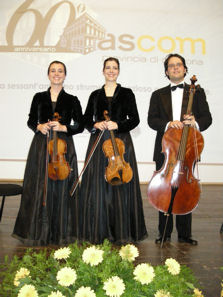 In
the same way a recent episode has been
very exciting and educational
for us. Last October for the 60th
anniversary celebration of the
Associazione Commercianti di Cremona, we
were asked to play three
fabulous instruments which are part of the
collection in the Palazzo
Comunale in Cremona; The 1715 “Cremonese”
violin made by Antonio
Stradivari, the 1615 by Antonio and
Girolamo Amati and the 1700 “ex
cristiani” cello by Antonio Stradivari. In
the same way a recent episode has been
very exciting and educational
for us. Last October for the 60th
anniversary celebration of the
Associazione Commercianti di Cremona, we
were asked to play three
fabulous instruments which are part of the
collection in the Palazzo
Comunale in Cremona; The 1715 “Cremonese”
violin made by Antonio
Stradivari, the 1615 by Antonio and
Girolamo Amati and the 1700 “ex
cristiani” cello by Antonio Stradivari.
Apart from the emotion felt by having
such an
honour – before
this moment the instruments had
been played together only once, on
23rd January 2007, by Salavatore
Accardo, Francesco Fiore e Rocco
Filippini – it
was extraordinary
experience to physically hear and play
chamber music on these
instruments in person. The richness of
harmonics and the mature tone
created a solid blend in the harmonic
sections and at the same time
each of the three instruments maintained
their distinctive
characteristics where the parts moved
independently. We went back to
our own instruments with some reluctance
but with a clear idea of what
to aim at.
Thanks also to the Vittorio Veneto
Competitions, we were able to
perform, during the prize-giving concert
in front of various organizers
of European Youth Music Associations and
this led to our concert tours
in Spain in 2006 and in Germany in 2007.
The last tour that we did (in
the Balkans in July 2007) was instead the
result of being selected in
the “CIDIM Nuove Carriere” Competition in
2006.
This was a decidedly wonderful experience
thanks also to the fact that
our concerts were part of a large project
which aimed at promoting live
music as a means to cultural
reconstruction in countries with clear
social difficulties. The attention given
to us and the deep respect
shown by the warm audiences we performed
for, made us feel very proud
indeed.
We have fond memories of those days.
In
particular
we will never forget the evening of the
concerti in Fojnica ( Bosnia ).
At the end of the concert we were invited
by some young people to a
traditional dinner that they had prepared
for us. They welcomed us to a
hall near the basilica where we played and
started to treat us like
royalty. We were embarrassed by so much
attention and fuss but we could
also sense a certain atmosphere of
expectation and embarrassment on
their part until one of them asked us
timidly if we would like to hear
some of their music.
From nowhere, about
twenty “tamburice” appeared (traditional
Bosnian guitars of various
sizes) and they started playing and
singing for us with incredible
enthusiasm. Then someone explained what
was happening. Our concert was
the first classical music event to take
place in their basilica, there
having been 15 years of silence due to the
war and they wanted to thank
us. We were moved. After a few pieces,
some of the girls started to
dance and before we knew it, we found
ourselves dancing traditional
Bosnian dances.
We could never have imagined that all this
was as a result of our
concert. That particular evening taught us
how music could really unite
people together, regardless of cultural
differences!
2008 also gave us unique experiences and
important goals. We recorded a
world premiére of
the transcription for string trio of
Bach's Goldberg Variations by Bruno
Giuranna. Bruno gave us his
unpublished score and suggested that we
analyzed, studied and deepened
the score, working together with him as
arranger and performers. We
feel that as a result we now perform this
version with his precise
interpretation and a better understanding
of the score! That's really
important for us because of the enormous
esteem that we have for
Giuranna, and also because the original
text by Bach doesn't present
time or dynamic indications which means
that the transcription is
inseparable from an executive idea.
We concluded our studies in chamber music
at the Accademia di Santa
Cecilia in Rome under the guidance of
Maestro Rocco Filippini (all
three with full marks) and at the Scuola
di Musica di Fiesole under the
guidance of Masters Andrea Nannoni and
Piero Farulli magna cum laude. |
 Meanwhile
we were guests of the International
Festival of Arts in
Harare ( Zimbabwe ) and, besides going for
the first time to Africa ,
we unwittingly become participants of a
particular cultural event. The
difficult socio-political context of those
months (the
festival
was
held
in late April, a few weeks after the
first
presidential election in which Mugabe
appeared the loser) was
not only experienced by
the organization and the involved artists
as a challenge, but produced
a very strong reaction in the population
and amongst local musicians. Culturally
the event was a rebellion against
the
political oppression they were
experiencing at that time. It was
therefore really touching for us to be
stopped at the end of the
concert by people who thanked us for
having participated and performed
for the "liberation of Zimbabwe ".
Before our arrival
in Harare , we thought that we
would just perform at some concerts in the
country. Instead we found
ourselves becoming involved in a cultural
movement, as musical
‘ambassadors’. This is something we
would never have imagined and
as a result, we have significantly
revalued the power of music, even
classical music! Meanwhile
we were guests of the International
Festival of Arts in
Harare ( Zimbabwe ) and, besides going for
the first time to Africa ,
we unwittingly become participants of a
particular cultural event. The
difficult socio-political context of those
months (the
festival
was
held
in late April, a few weeks after the
first
presidential election in which Mugabe
appeared the loser) was
not only experienced by
the organization and the involved artists
as a challenge, but produced
a very strong reaction in the population
and amongst local musicians. Culturally
the event was a rebellion against
the
political oppression they were
experiencing at that time. It was
therefore really touching for us to be
stopped at the end of the
concert by people who thanked us for
having participated and performed
for the "liberation of Zimbabwe ".
Before our arrival
in Harare , we thought that we
would just perform at some concerts in the
country. Instead we found
ourselves becoming involved in a cultural
movement, as musical
‘ambassadors’. This is something we
would never have imagined and
as a result, we have significantly
revalued the power of music, even
classical music!
Barbara,
Giada
and
Klaus Broz
|
|
|