 |
Divertimento
NEW!
W.A.Mozart: Divertimento KV563
F.X.Süssmayr: Trio in D - world première
recording
Label: Universal (2011)
|
|
In the 220th anniversary of
Mozart's
death, the homage of Trio Broz to
the great composer
and the world première recording of the trio
wrote in the same
year by the pupil and friend Süssmayr:
time:
54'57"
booklet languages: Italiano / English /
Deutsch
HD HIGHT DEFINITION RECORDING AND
MASTERING, 24 bit 96 kHz
Recording: Sala
San Giuseppe
(Rovereto – TN)
August 2010
|
 |
"There
is a kind of
awkward external presence that links
Mozart’s
Divertimento (Trio) in E-flat for
Strings (the last in a series of such
compositions for violin, viola and
cello) and Franz Xaver
Süssmayr’s similar (but solitary)
Trio in D: the unfinished
Requiem in D minor. Perhaps because, as
everyone knows, the name of
Süssmayr as a historical figure and
a composer is inextricably
connected with the completion of that
score; or else because Mozart’s
work was written in the autumn of 1788
for his friend and fellow
Freemason Johann Michael Puchberg, to
whom he (successfully) addressed
the most pressing pleas for money:
«Tomorrow, Friday, Count Hadik
has asked me to let him hear [...] the
trio I composed for you»,
Mozart wrote in a letter to him on 8
April 1790, referring to the
Divertimento. But Puchberg was also one
of the minor figures involved
in the tortuous events that accompanied
the commissioning of the mass
for the dead. He had a shop and a room
in a building belonging to Count
Franz Anton von Walsegg in the Wiener
Neustadt area. As a result of the
loans that Puchberg had made to Mozart,
he had no difficulty in acting
as the bearer to the composer of a
request from the provincial
aristocrat, who wished to associate a
harmless vanity – paying
musicians to write works that he then
copied out and passed off as his
own – with the desire to commemorate the
recent death of his young
wife. Walsegg would certainly never have
wanted to enter history on the
basis of his naive (and in those days,
before authors’ rights,
permissible) musical eccentricity.
It is only the
extraordinary closeness between the
posthumous publication date of the first
work and the presumable period
of gestation of the second that places
them in proximity: the
compositions themselves seem to belong
to different centuries. Mozart
bears most of the responsibility. His
Divertimento was produced in a
period of creative fervour and successes
(the Viennese premiere of Don
Giovanni) but also decisions with a
testamentary tang – such as the
resolve to conclude the series of
Symphonies (the Jupiter was finished
on 10 August) and, almost, the piano
Concertos (the Coronation Concerto
in February) – and in it he expresses
himself with a maturity and
modernity of thought inversely
proportional to its instrumentation.
The Divertimento was
the third chamber composition
written within a few months for
Puchberg, to whom the Piano Trios K 542
and K 548 had been dedicated. In this
case, too, the dedication was
not disinterested. «I am
free to invite you. Häring
will play it. – I would have come to you
myself to talk to you
personally, but my head is bandaged up
because of rheumatic pains,
which make me feel my situation even
more keenly», he wrote in
the same letter of 8 April.
«Please help me once again with
what
you can afford, just for now – and
forgive me.» Mozart had
initially begun another piano Trio (in G
major) but then decided to go
back to a genre that he had used several
times in his youth..."
Angelo
Foletto
|
|
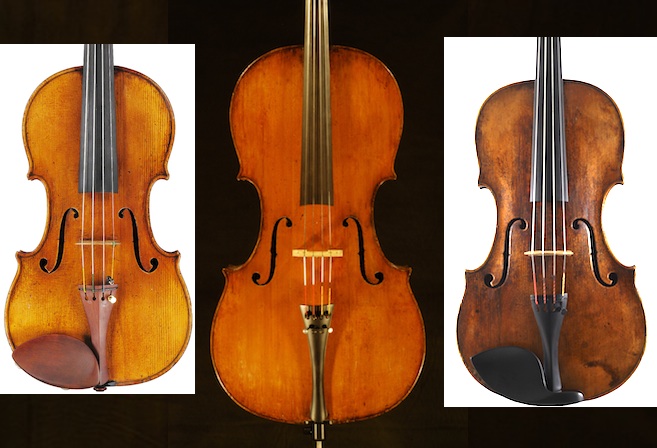
The instruments
For this recording
Trio Broz played on a special trio of
instruments:
Violin Giuseppe
Antonio Rocca, Torino, 1839
Viola, scuola milanese,
secondo
quarto del XVIII
secolo
Violoncello Louis Guersan,
Parigi,
1743 |
|
|


 Only on this site, you can purchase the CD
with original autograph and
dedication by Trio Broz. Click here to go to the
shop.
Only on this site, you can purchase the CD
with original autograph and
dedication by Trio Broz. Click here to go to the
shop.